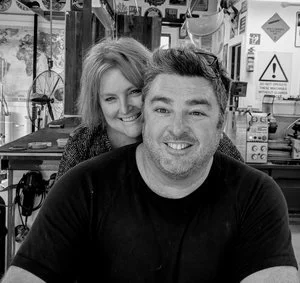
I wrote some weeks ago about digital glimmers, those photo reminders of times past and how they bring a little bit of positivity into my life.
Not this week.
Instead, I was confronted with a photo of our Mexican-inspired backyard. In 2003, we were at our absolute lowest. Another round of IVF had failed, dragging us deeper into the mire. I had recently attended a conference in Oaxaca, Mexico, and came home inspired by the rich architecture and vivid colours. Desperate to inject some light into what had become a profoundly sad existence, I convinced Vickie that we should redesign the garden with a Mexican theme.
And we did. In hindsight, I would have handled things differently, but we did the best we could with the knowledge we had at the time.
Looking back over decades of navigating a failed path to parenthood, renovating or restyling the house and garden always seemed to align with our most traumatic chapters. Always being behind the eight ball financially, moving was never an option. Renovating was our only way of exorcising the ghosts of those devastating times.
So that photo of our Mexican garden from 2004 wasn't a glimmer; it was a trigger. It reignited an anger that has been lurking beneath the surface for some time.
A little over a year ago, two things collided. First, I joined a consumer advisory group for a major fertility research project. I keep the details vague to protect my seat at the table, because it is vital that we, the childless, have a voice and use our experience to keep these projects anchored in reality rather then what society is ‘led’ to believe. But being in that room put the cold, hard data of IVF outcomes directly in front of me.
Around the same time, I was invited to speak at the Fertility Society of Australia and New Zealand (FSANZ) annual conference, I was asked to speak on my lived experience of IVF. I channelled every ounce of that anger into my presentation. I doubt I will ever receive a return invite; I was probably viewed as a bit of a loose cannon because I refused to sugarcoat the truth. That fire was stoked even further by members of our online community who generously shared their lived experiences with me and gave me permission to tell their stories.
I realise I risk preaching to the converted here. If you haven’t lived this, it’s easy to look away, which is exactly why you need to read on.
Fertility treatment is an isolating, suffocating bubble. You become so consumed by the process that you inadvertently shut everyone else out. You ride a punishing roller coaster of hope and despair, completely unaware that you are slipping closer and closer to clinical depression. And because clinics continually pitch an "80% or 90% success rate," you convince yourself that you are the sole failure in a room full of winners.
"History is written by the victors."
— Winston Churchill
Because fertility history is written by the victors, those selective success stories have convinced society that IVF is a modern medical magic wand. Mention your struggles to anyone, and without fail, they will chime in: "Oh, but I know someone who had a baby on their fourth round of IVF! You’ll be fine!"
No, you bloody aren’t.
As Craig put it in an article for the ABC by Kellie Scott : (Here)
“IVF is a constant ride of brutality.”
For men, that brutality comes with an unspoken expectation to be the immovable anchor. You are expected to hold your partner together, absorb the crushing blows of negative results, and swallow your own grief in silence. You become a bystander to physical trauma and an invisible participant in your own psychological ruin.
Yet you keep buying tickets for that brutal ride because the industry dangles those 80% to 90% figures. What clinics rarely explain—and seldom ensure vulnerable patients truly understand—is the sleight of hand behind those numbers. Those headline rates usually refer to cumulative "clinical pregnancies" over multiple cycles under optimal conditions, or early biochemical markers.
A positive blood test or an early ultrasound sac is not a baby coming home in a bassinet.
The average official rate of taking home a baby per initiated IVF cycle in Australia sits at around 27%. That means roughly 70% to 75% of individual cycles fail. If a woman enters assisted reproductive treatment between the ages of 40 and 44, a staggering 70% leave without a child. Overall, between 35% and 50% of everyone who steps onto the fertility treatment treadmill will walk away permanently childless.
Two community members captured this reality with painful clarity:
“I remember thinking at the time that these clinics are nasty little places that prey on extremely vulnerable women
and ‘sell’ a dream without giving real clarity to the real outcomes that are possible. They then throw you away when it doesn’t work.”
— Betina
“I felt taken advantage of in my grief and desperation and sold a dream.”
— Emily
The magnitude of this cannot be overstated.
When an IVF cycle fails, it is not merely a failed medical procedure; it is a profound, traumatic bereavement. Researchers have repeatedly found that the psychological distress, anxiety, and depression experienced by women undergoing unsuccessful fertility treatments are comparable to individuals diagnosed with cancer, hypertension, or recovering from a heart attack. After just two failed cycles, an estimated 94% of women experience symptoms of severe depression, and 13% report suicidal ideation. Nearly half of all fertility patients rate the experience as the absolute worst trauma of their lives.
It strains partnerships to breaking point. Intimacy becomes scheduled and clinical, the home becomes a pressure cooker of anxiety, and every two-week wait is an agonising purgatory between desperate yearning and impending grief.
What makes this loss uniquely cruel is that it is entirely disenfranchised.
When a family member dies, society steps up. There are rituals, sympathy cards, cooked meals delivered to your door, and bereavement leave. When an embryo fails to implant, there is only silence. There is no body, no service, and no collective mourning. You are expected to wipe your tears, take some painkillers for the cramping, and turn up to work on Monday morning pretending your entire world hasn't just imploded.
Instead of empathy, you are pelted with dismissive platitudes:
"Just relax, it’ll happen when you stop stressing."
"You can always do another cycle!"
"At least you know you can try."
And what happens when your finances run dry, or your body and mind simply cannot endure another needle?
They show you the door.
Reproductive medicine is structured entirely around conception, not resolution. Once you cease to be a paying patient, the care vanishes. People are routinely discharged with little more than a brochure or unhelpful advice to "find a new hobby," completely abandoned without psychological off-boarding to navigate the monumental shift into involuntary childlessness.
“Can you believe that it took me three days to front up to listening to the IVF podcast
even though it is thirty years since my husband and I came to a full stop with IVF?”
— Maryanne
Couples rarely walk away because they stopped wanting a family. They stop because of sheer emotional, physical, and financial exhaustion. They hit a wall. Drawing that line in the sand is not surrender; it is a desperate act of self-preservation.
“Nobody tells you that life will never be the same after IVF.”
— Charlene
The next time someone casually offers IVF as an easy fix, here are a few suggestions:
“IVF is not a guaranteed outcome - roughly 70% to 75% of individual cycles fail, and 70% of woman over 40 leave assisted reproduction without a baby”
“The emotional and psychological toll of failed treatment is clinically equivalent to facing cancer or heart disease; it is not a casual routine anyone can simply endure indefinitely.”
“Walking away from treatement isn’t giving up; it is surviving an invisible, non-finite loss that society continuously refuses to acknowledge.”
To the decision-makers, clinicians, and marketers in reproductive medicine: the bar cannot remain this low. Stop selling statistical illusions to vulnerable people, and start building care that extends beyond the cash register.
That 2004 Mexican garden has long since been dismantled—another physical exorcism. Today, we are deep into our second garden redesign. As our peers step into the grandparenting phase of life, that familiar chronic grief is resurfacing in yet another new way.
So once again, we are laying down new soil, putting up new structures and rebuilding a meaningful life on our own terms. Equipped with greater knowledge and insight into managing lifelong grief than we possessed in 2003, we are creating a sanctuary where we can both find lasting peace.