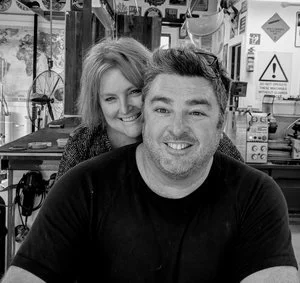
Grace, Grief and Boundaries: Finding Unity in a Childless Marriage
The topic of boundaries is a very common topic within the childless not by choice wider community and is a very frequent discussion in our Full Stop online community. We recently also discussed the topic with Sandy Langhart Michelet, author of ‘My family tree stops with me and founder of The childless life.com. Pondering on this and through discussions with Vickie I was propelled to write this piece as an extension of what I wrote for our latest newsletter. Boundaries are viewed differently in our household and I’m sure we are not the only couple that have this discussion.
How do two people in the same marriage view the exact same boundary but through entirely different lenses.
Although from the outside looking in, some might think we have it all together, we still struggle with the complexities of childlessness, although we have found what triggers these as we age are different and compounding. But the constant through all our management strategy is the boundaries we set up. They help us navigate our ‘different’ life and whilst they have been extremely helpful, they come with their own challenges. Many we have met have perceived our boundaries as walls we built to keep people out, when in fact they are not about being anti-social or difficult. They were and still are in place to create enough breathing room so that the grief we carry doesn’t suffocate us.
Early on, trying to live a ‘normal’ life, doing the ‘expected’ things, like celebrating friends who have had babies, attending birthday parties, we were confused as to why we just felt so low after these events. In hindsight now nearing sixty with a lifetime of understanding we know we were feeling grief, but back then we were just confused.
I have to say that I would have most likely have kept doing the ‘right’ things, I would say that I was most likely in a bit of denial, whereas Vickie was deep in grief. This caused her to set a very firm set of boundaries; she realised years of "doing the right thing" only to end up emotionally spent needed to change and so we decided;
We don’t go to see people with newborns in the hospital.
We don’t go to baby showers.
We usually wait until the mum has stopped breastfeeding before we visit.
We both decided not to go to children’s birthday parties.
Vickie found it hard in her really "griefy" days to communicate these boundaries, even though she knew they were the best thing for her. I was worried that shutting out the world was not healthy for us and so pushed back a little. I’ve always been a bit of a "White Knight"—the guy who sees a problem and wants to grab a toolbox. My logic was simple: Context equals understanding. I believed if we told people ‘why’ we couldn't attend a child’s birthday or a baby shower for example; they’d see our pain and give us grace. For me its comes from a place of self-preservation – a fear of being misunderstood or labelled “bitter” or “weird”. I’ve also taken the route of taking control of the narrative to prevent others from filling in the blanks with their own assumptions and in my opinion this swings the power balance of the situation back into my favour. Vickie saw it differently. Through the hazed filter of grief, guilt, and shame, she felt that our reasons were private. To her, "explaining" felt like "defending" our right to exist and this felt wrong to her.
But after a lot of discussion both between us and on our psychologist’s couch, we agreed on some rules.
We don’t talk about the reason why we couldn’t have children, unless we feel we are in a space that feels right for us. We take the view it is a ‘our’ issue, not a her or me issue to preserve our self-esteem and show unity. This role also played right into my need to be the protector
We agreed after a lot of negotiation I would be the one to inform people of our choices not to attend events and provide context. I also deal with all the questions that might come from this as well.
Before any communication about us is delivered, we both must agree on the content. So far, this has worked for us.
A challenge we found was that not everyone accepted our wishes the way we expected, there were several times we didn’t get that ‘grace’. One family member, for example, even after being given all the context, still thought we were being selfish and that we "needed to get over it." Due to this and other issues, they no longer have a place in our life.
On the other hand, Vickie’s "new" sister (a story for another time) was much more understanding. When she came into our life, she and her husband had a toddler and really wanted us to participate in birthdays and other milestones to make up for lost time. We declined, with context.
What was lovely was that she then thought about it and came back to us with a suggestion: “How about the week after, we get together just the three of them and us two for a little celebration?” This worked. Vickie got to be part of her new niece’s life, but we didn’t have to feel like the odd ones out, waiting for those awkward questions that would inevitably come from the other parents at a big party. We didn't have to leave feeling horrible because we’d been witnesses to a joyous occasion that simply reminded us of the hole in our hearts. Even after the special little party, we’d still have a painful reflection on the trip home, but it was manageable.
Boundaries are important and, at the same time, complex depending on who needs to understand and abide by them. Giving people context is also important; it gives them the opportunity to look for other ways to include you in their lives. But, yes, this may fall on deaf ears. That is, unfortunately, part of the tapestry of life. Boundaries don't make the pain vanish, but they give you the room to catch your breath and find a manageable way through the day.